We couldn’t agree more that there is a need for customizing impact measurement to investees, and the Common Approach standards can do just that.
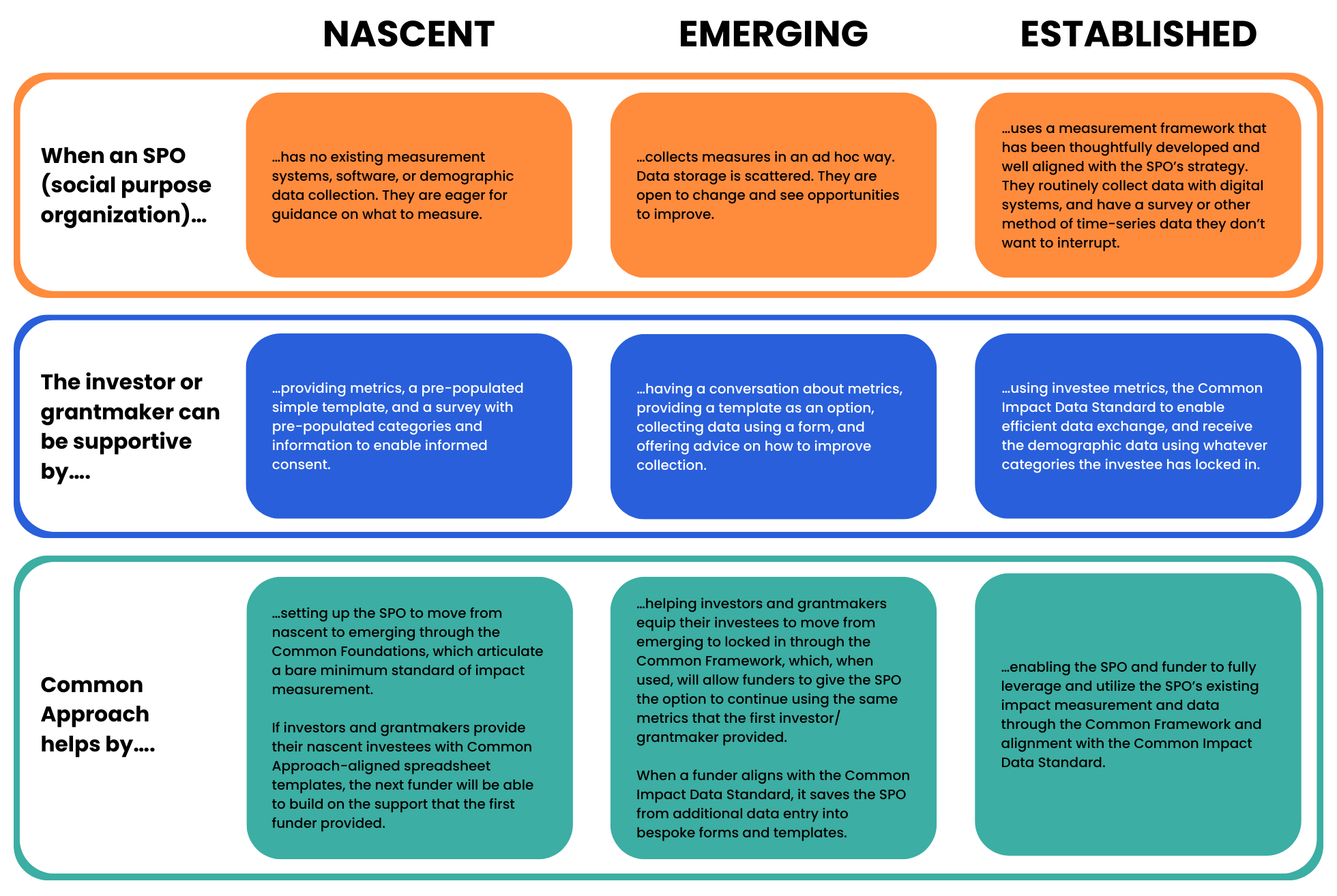
Building on Ormiston’s observations and the theory of lock-in, we have segmented social purpose organizations (SPOs) into three categories:
- Nascent, when the organization has no existing impact measurement system.
- Emergent, when the organization is beginning to take ownership of metrics that work for them. They are thinking strategically about their purpose and those they serve and what data they need to make decisions; however, they remain funder-driven and are working to find their own footing.
- Established (our term for locked in), when the social purpose organization (SPO) is confident in adapting its metrics to stay aligned with evolving strategy and insight, and is not at all funder-driven. If the SPO undertakes additional measurement to comply with funders, it is out of obligation.
These categories consider not just impact metrics, but also digital infrastructure for measuring impact (the digital tools, such as software, that collect, store and exchange data), and data on the demographics of their management and board.
In our work, SPOs who are established demonstrate it in three related areas, all associated with how they measure and report their impact.
- Social purpose organizations are established in specific impact measures and measurement approaches when they have sufficient experience to know what metrics they need to manage; when they know the metrics that those they serve find meaningful, and when they have built data collection systems around certain metrics.
- Social purpose organizations are established in data collection, data structure and data storage after they have invested significant time into their systems. They may have undergone a significant process of choosing and onboarding software, such as a Salesforce customization or impact measurement software. Or, they may have developed complex and intricate spreadsheets that seamlessly populate impact management dashboards.
- Social purpose organizations are established in specific demographic data collection once they have undertaken a thoughtful, likely time-consuming, exercise on how to collect this data and what categories to use.
We believe that it is a good thing when SPOs are established. It takes time for an SPO to get their impact measurement systems to a point where they can use the data to make decisions and improve their work. Once they have figured out their systems and fully own their impact measurement, investors telling them what to do or requesting they do additional things becomes burdensome and interferes with the measurement.
This burden doesn’t impact locked-in organizations alone—we observe that when a grantmaker or investor imposes metrics and forms on emergent SPOs, it prevents them from becoming established. While emergent organizations are trying to think strategically and take ownership, imposed measurement keeps them in a funder-reporting trap that supplants the work of aligning measurement with management and makes finding their footing that much harder.
Each of these three categories have unique needs, and imposing the best practices for one category onto another category will never have the desired results. Investor behaviour that is ideal (helpful, non-burdensome) for an SPO with nascent systems will be burdensome and unhelpful to an SPO that is established, and vice versa.
Ormiston’s findings help us understand the disconnect between organizations that thrive under top-down metrics and those that struggle with them. The tension isn’t ungrateful SPOs or unhelpful investors, but the use of one-size-fits-all approaches for impact measurement. Corresponding to the author’s conclusions and Common Approach’s ethos, the solution to this burden is flexibility. Nascent, emergent and established create a useful framework for investors to employ flexibility in their approach by understanding the impact measurement needs of SPOs and tailoring their impact data collection accordingly. Common Approach is here to help investors support those locked-in enterprises, and help others on their journey towards that moment when impact measurement and management clicks.